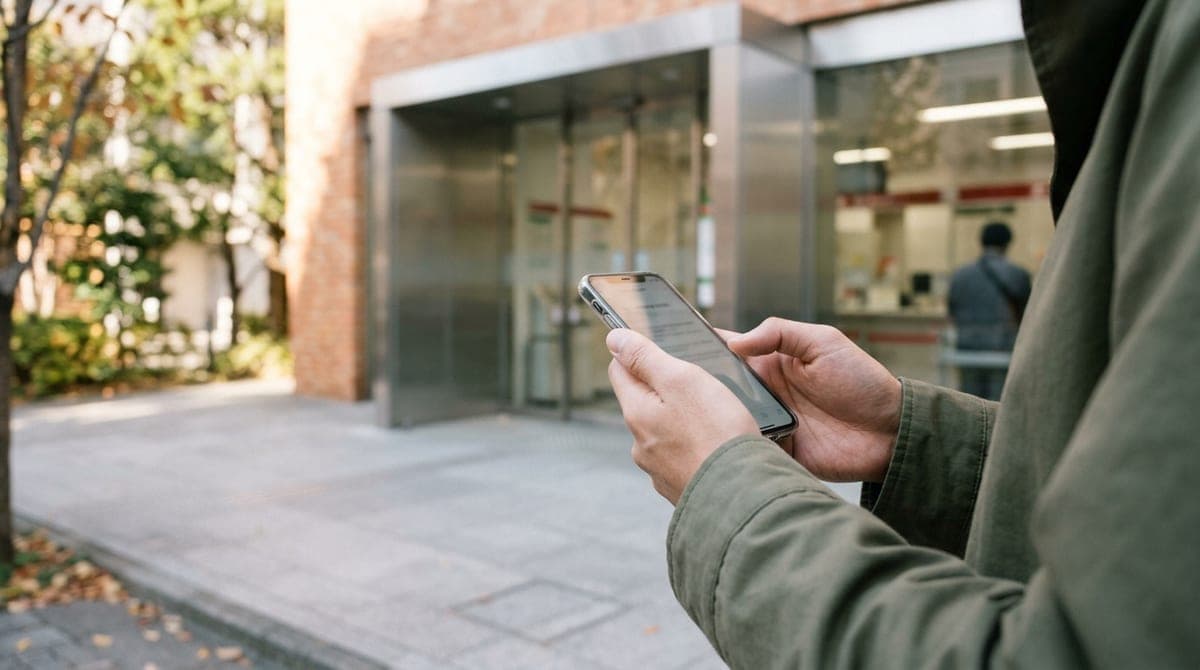
To open a Japan Post Bank account as an international student, you can apply online using the official Yucho Tetsuzuki App or visit a post office branch in person. You will need your residence card with your registered address printed on it, a passport, and your student ID card. Applications submitted through the app generally take about two weeks to process, while counter visits require an advance appointment and sufficient Japanese language skills or an accompanying interpreter.
Why do international students in Japan need a Japan Post Bank account?
Setting up a domestic bank account is an essential life procedure when arriving in Japan as an international student. Receiving scholarship funds, earning income from part-time jobs, paying tuition, and setting up automatic transfers for utility bills or credit cards all require a local Japanese bank account. Using a bank account from your home country while residing in Japan often results in currency conversion fees and international transaction charges.
Furthermore, Japanese government scholarship recipients (such as MEXT scholars) and Honors Scholarship (Gakushu Shoreihi) recipients are required by their programs to open an account with Japan Post Bank to receive their monthly funds, as explained by Nagoya University Living Guide and The University of Osaka. Standard bank operating hours at counter locations in Japan run from 9:00 am to 3:00 pm on weekdays (Monday through Friday). Outside of these hours, cash withdrawals and deposits can be completed using automated teller machines (ATMs), though off-peak hours or using another institution's ATM may incur transaction fees.
What are the two ways to apply for a Japan Post Bank account?
Students can choose between two main application methods to open an account with Japan Post Bank: applying digitally via a smartphone application or making an in-person visit to a post office counter.
Applying via the Yucho Tetsuzuki App
The digital method uses the dedicated Yucho Tetsuzuki App to set up a paperless general account called "Yucho Direct Plus." This option does not issue a physical paper passbook; instead, account holders manage balance inquiries and remittances online or with a cash card.
To apply through the app, you need:
- A smartphone capable of downloading Japanese mobile applications.
- An email address accessible within Japan and a smartphone keyboard configured for Japanese input.
- Your official residence card with your address registered by the municipal office.
- Your valid student ID card (or official certificate showing enrollment).
As noted by the Graduate School of Mathematical Sciences at The University of Tokyo, user guidance manuals for the app are published in English, Japanese, Chinese, and Vietnamese. Account setup and cash card delivery via the app typically take approximately two weeks. However, holders of a Specific Residence Card cannot use the app service, and katakana display names in the online Yucho Direct system are capped at 30 characters.
Applying in person at a post office counter
If you cannot use the application, you can complete the process at a physical post office branch. According to Tottori University International Exchange Center, students visiting a counter must book an advance appointment online or by phone before visiting.
Because branch procedures are conducted entirely in Japanese, students who are not fluent in Japanese should bring an interpreter or a companion who speaks Japanese fluently. Post office staff may refuse to open an account if clear communication cannot be established. Processing times at branch counters can range from same-day completion to over two weeks if background security verifications are needed.
What documents and items do you need to open an account?
When preparing your application, ensure you have gathered all mandatory identification and verification items:
- Residence Card: Your residence card must have your current residential address printed on the back after completing residence registration at your local ward or city office.
- Passport: Your original valid passport.
- Student Identification: A valid student ID card, letter of acceptance, or enrollment certificate specifying your period of study.
- Personal Seal (Inkan/Hanko): While optional or substituted by signatures at some locations, bringing a personal seal is recommended for counter applications.
- Application Form: Completed online or obtained at the post office or international student division.
- My Number (Individual Number): Required if you intend to send or receive international remittances.
What is the difference between non-resident and resident bank status?
Under the Foreign Exchange and Foreign Trade Act of Japan, foreign nationals living in Japan for less than six months are legally classified as "non-resident" customers by financial institutions. Furthermore, individuals residing in Japan for less than three months may not be eligible to open an account at certain post office locations or banks.
Holders of a "non-resident" account face restrictions on financial transactions:
- Domestic transfers between accounts in Japan may be treated as international transfers, resulting in significantly higher transaction fees.
- Overseas remittances and foreign fund transfers have specific limitations and mandate the registration of your My Number.
Once you have completed six months of legal residence in Japan, you can visit your local Japan Post Bank branch to submit an application to update your account status from "non-resident" to "resident," unlocking standard domestic transfer fees and features.
What crucial rules and obligations must bank account holders follow?
To maintain your bank account in good standing, you must observe strictly enforced administrative and legal obligations:
- Report Status Updates: You must immediately notify Japan Post Bank whenever you renew your residence card, extend your stay, or change your residential address.
- Cancel Upon Departure: Before moving out of Japan or returning to your home country permanently, you are required to visit a branch and complete the formal account cancellation process.
- Strict Prohibition on Account Transfer: Giving, selling, or lending your bank account, passbook, or cash card to any third party is strictly prohibited under Japanese law. Transferring account details for use by others is a criminal offense, even if requested by an acquaintance.
Finding a place to stay
Before you can open a bank account in Japan, you must first visit your local city or ward office to complete residence registration and have your residential address printed on your residence card. For international students, arranging accommodation should be completed after your Certificate of Eligibility (COE) and student visa are issued, prior to arriving in Japan. When arriving in Tokyo, many newcomers stay in a furnished monthly apartment first while transitioning into university life. OHAYO Stay offers furnished monthly apartments and rooms in Tokyo. The monthly price includes electricity, gas, water and Wi-Fi. No guarantor, no key money and no agency fee; booking is online with a passport or ID and a credit card. Securing your housing early ensures a hassle-free address registration process upon arrival.