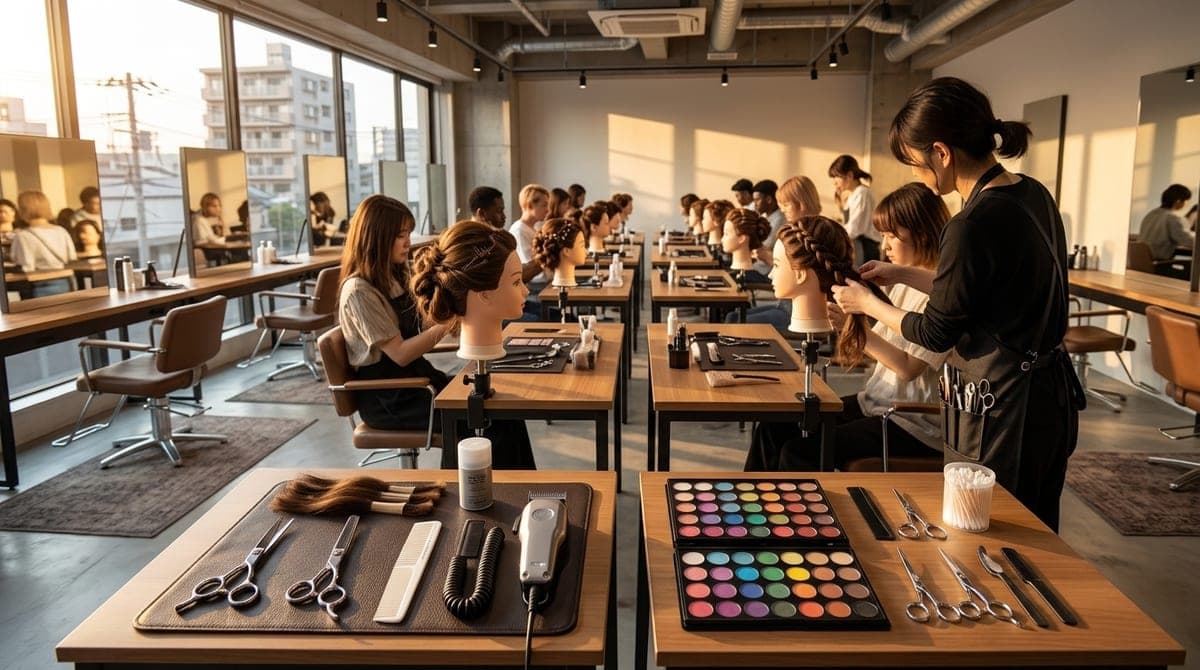
In Japan, qualifying as a professional barber or beautician requires graduating from a vocational school or junior college designated by the Ministry of Health, Labour and Welfare (MHLW) and passing the national examination. Barbering and beautification are legally distinct professions under separate Japanese laws, each granting exclusive rights to specific procedures like facial razor shaving or eyelash extensions. International students preparing to study beauty in Tokyo or across Japan in 2026 must understand these statutory differences, curriculum requirements, and examination structures.
What is the legal difference between barbering and beautification in Japan?
Under Japanese law, barbering and beautification were originally governed together under the 1947 Barber Law, which was updated to the Barber and Beautician Law in 1951 before the Beautician Law was established as a separate law in 1957 (Kokusai Bunka Technical College). According to MHLW regulations:
- Barbering (Riyou): Defined as neatening appearance through hair cutting, facial shaving, and related techniques. Full facial shaving with a razor is a regulated monopoly restricted exclusively to licensed barbers.
- Beautification (Biyou): Defined as beautifying appearance through permanent waving, hair styling, makeup, and cosmetics. Procedures such as eyelash extensions, professional makeup, and kimono dressing fall under the beautician domain. Light facial shaving incidental to makeup is allowed for beauticians, but full razor shaving is not.
According to MHLW administrative reports cited by Yamano College of Aesthetics, 2022 statistics showed 204,883 active barbers and 571,810 active beauticians in Japan. Over a 10-year period, active barbers decreased by 33,203 while active beauticians grew by 92,301, resulting in almost three times more beauticians than barbers nationwide.
What are the training requirements at MHLW-designated vocational schools?
To sit for the national examination, candidates must complete a prescribed program at an MHLW-designated training facility, such as a specialized training college (senmon gakko) or junior college (Yamano College of Aesthetics). The required duration depends on the study mode:
- Daytime and Nighttime Courses: Require at least 2 years of study (minimum 2,010 class hours for daytime programs).
- Correspondence Courses (Tsuushin): Require at least 3 years of study (minimum 305 to 610 training hours depending on salon employment status).
The core curriculum covers shared subjects including related laws and regulations, hygiene management (infection control and disinfection), health (human anatomy and skin science), cosmetics chemistry, and cultural and technical theory. Practical training focuses on specific technical competencies tailored to each qualification. Foreign students should note that visa conditions and visa status changes after graduation must always be confirmed directly with official immigration authorities and school admission offices.
How does the national exam work and what are the pass rates?
The national examination is administered twice a year (Spring/Winter and Autumn/Summer) by the Barber and Beautician Examination and Research Center (Kokusai Bunka National Examination Guide). Both exams consist of two mandatory parts:
Written Examination
The written test comprises 55 questions across five subject areas: Related Laws and Regulations/Operation Management, Hygiene Management (Public Health, Infection, Disinfection), Health (Anatomy, Skin Science), Cosmetics Chemistry, and Cultural/Technical Theory. To pass, candidates must score at least 60% overall and avoid getting a zero score in any single subject category.
Practical Examination
- Barber Practical Test: Evaluates hair cutting (medium cut and thinning/senning cut), razor shaving with facial treatment, and hair styling. Candidates must keep technical deductions at or below 40 points and hygiene deductions at or below 20 points.
- Beauty Practical Test: Evaluates Layer Cut (Task 1) and either Winding or All-Wave Setting (Task 2), alongside strict hygiene standards. Task 1 and Task 2 allow a maximum deduction of 30 points each, with hygiene deductions capped at 20 points.
In the 53rd Spring Exam held for 2026 graduates (Kokusai Bunka National Examination Guide), 1,431 barber examinees sat for the test with an 81.8% pass rate (1,171 passed), while 19,850 beautician examinees took the exam with an 87.0% pass rate (17,273 passed). Spring exams typically see higher pass rates because most full-time daytime students take them, whereas Autumn exams mainly serve correspondence students.
The exam fee for both practical and written components is 25,000 yen (50th exam basis). Upon passing, license registration requires a 9,000 yen registration tax, a 5,200 yen fee, and a medical certificate from a physician.
What are the dual license options and recent legal changes?
Since an April 2018 legal revision, acquiring both barber and beautician licenses (dual licensing) has become significantly easier (Kokusai Bunka Technical College). Individuals who already hold one license can complete the second course in a reduced timeframe—shortened to 1 year for daytime/nighttime courses or 1.5 years for correspondence courses—due to exemptions in overlapping general subjects. Additionally, since 2016, establishments employing dual-licensed practitioners are permitted to register as combined barber-beauty facilities.
Finding a place to stay
When moving to Japan to attend a beauty vocational school, organizing your accommodation at the right time is essential. Most international students secure their living arrangements after receiving their Certificate of Eligibility (COE) or student visa, shortly before arriving in Tokyo. Look for housing with convenient transit routes to your campus, as daily attendance for full-time 2-year programs is strict. OHAYO Stay offers furnished monthly apartments and rooms in Tokyo, eliminating the need to buy furniture upon arrival. Most homes have a minimum stay of 30 nights (shown on each listing). No guarantor, no key money and no agency fee; booking is online with a passport or ID and a credit card.