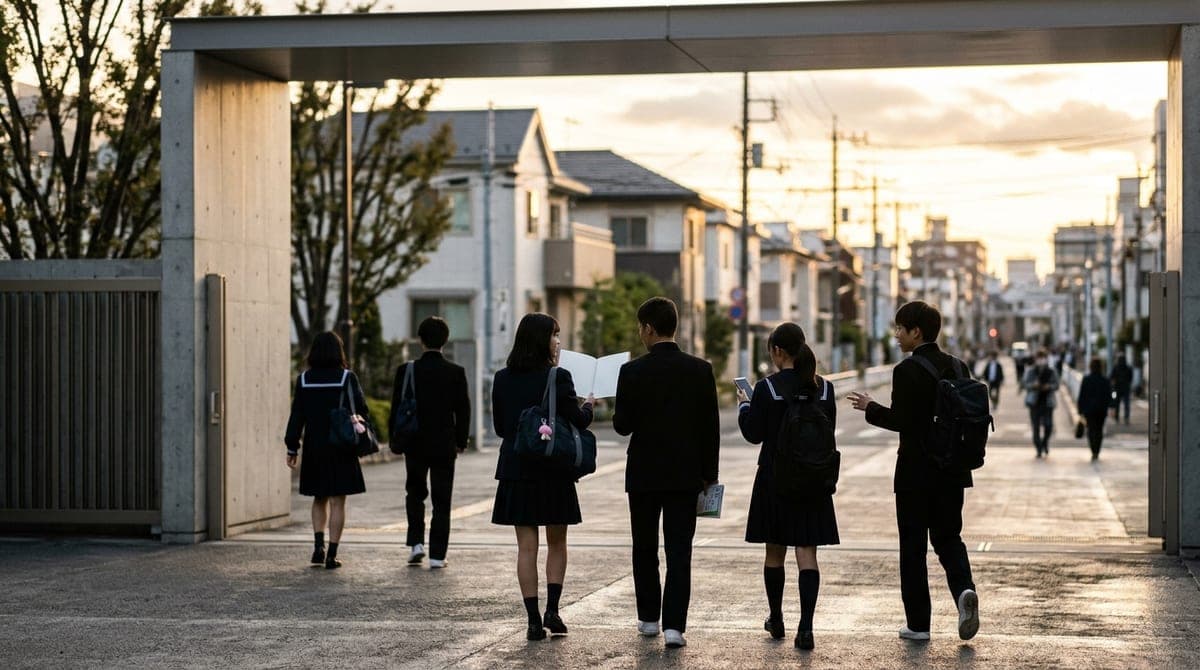
Foreign families moving to or residing in Japan can access financial assistance for high school tuition through the national High School Tuition Support Fund (Shugaku Shienkin) in 2026, depending on their residence status and school classification. Following legal revisions effective April 1, 2026, income caps for the main national program have been eliminated, providing tuition relief to a much wider range of students. However, foreign nationals holding specific visa statuses like Student (Ryugaku) and students at standard unapproved foreign schools remain subject to separate rules or exclusions.
What is Japan's high school tuition support system in 2026?
The High School Tuition Support Fund is a national government initiative designed to ensure that all high school students can receive an education regardless of their economic situation. Under the updated framework implemented on April 1, 2026, the national government removed income limits for its primary tuition grant scheme, significantly expanding coverage for enrolled pupils. Details on national policies are published on the official MEXT High School Tuition Support Page.
In addition to national funds, prefectural governments provide supplemental subsidies. For instance, families living in Tokyo attending private high schools in the capital can combine national support with the Tokyo Private High School Tuition Reduction Grant to receive up to 501,000 JPY annually, which covers the average private high school tuition in Tokyo. Further details can be found on the Tokyo Metropolitan Government Shugaku Shienkin Page.
Which foreign students are eligible for high school tuition support?
What residence statuses qualify for standard Shugaku Shienkin?
To qualify for standard national tuition assistance, a student must reside in Japan and hold an eligible status. According to the MEXT High School Tuition Support Q&A, eligible categories include:
- Permanent Residents (永住者) and Special Permanent Residents
- Spouses or Children of Japanese Nationals or Permanent Residents
- Long-Term Residents (定住者) with recognized intent to permanently reside in Japan
- Dependent visa holders (家族滞在) who graduated from a Japanese elementary and junior high school (including compulsory or special needs education) and demonstrate intent to work and settle in Japan after high school graduation
Students entering Japan on a Student visa (留学) on or after April 1, 2026, do not meet the residence status requirements for standard tuition support. Visa eligibility criteria are strictly regulated; families should confirm their precise immigration status with official authorities.
What support exists for students ineligible under standard rules?
Foreign students who do not qualify for standard Shugaku Shienkin due to visa status or school type may still be eligible for alternative assistance schemes:
- Transitional Measures: Students enrolled on or before March 31, 2026 (including enrolled pupils at foreign schools designated under the former system), continue to receive support equivalent to previous income-based rules.
- New Study Support Scheme (高校生等・新修学支援): Newly enrolled foreign students entering on or after April 1, 2026 (excluding Student visa holders) and students attending foreign schools may receive financial aid based on household income criteria.
Are international schools and miscellaneous schools covered?
Standard Shugaku Shienkin covers public, national, and private high schools (full-time, part-time, and correspondence), secondary education schools (latter course), special needs high schools, colleges of technology (years 1–3), and upper secondary courses at specialized training colleges.
General international schools classified solely as miscellaneous schools (kakushu gakko) are generally excluded from the primary Shugaku Shienkin program unless they offer designated national qualification training programs or fall under specific transitional frameworks. Support schools (support-ko) that assist students enrolled in correspondence high schools are also excluded, though tuition for the correspondence high school itself is covered.
How much tuition assistance can eligible students receive?
Assistance amounts vary depending on whether the institution is public, national, or private:
- Public High Schools: Full-time students receive 9,900 JPY per month; part-time students receive 2,700 JPY per month; correspondence students receive 520 JPY per month.
- National High Schools: Students receive 9,600 JPY per month.
- Private High Schools: Full-time and part-time students receive up to 38,100 JPY per month (457,200 JPY annually). Correspondence students receive up to 28,100 JPY per month (337,200 JPY annually or 13,668 JPY per credit).
- Colleges of Technology (Kosen 1st–3rd year): Public students receive 19,550 JPY per month; private students receive up to 38,100 JPY per month.
The standard maximum payout duration is 36 months for full-time courses and 48 months for part-time or correspondence courses. Additional support like the High School Supplemental Scholarship Fund (高校生等奨学給付金) provides non-repayable aid for non-tuition educational expenses (textbooks and supplies) for income-eligible families.
How and when do families apply for high school tuition support?
Applications are not submitted directly by individual families to the national ministry; instead, materials are distributed by the high school during orientation or after enrollment. Most prefectures utilize online submission systems such as e-Shien or local portals like Tokyo's LoGo form.
Application windows are set by local governments and individual schools. For example, Tokyo private high schools conducted annual applications between June 1 and June 30 in 2026 using login IDs or application numbers supplied by the school. Support begins in the month the application is submitted.
Finding a place to stay
Relocating to Tokyo with school-aged children requires carefully timing your accommodation arrangements alongside visa issuance and school admission procedures. Many foreign families prefer to set up temporary housing first while completing high school enrollment and prefectural subsidy applications. OHAYO Stay offers furnished monthly apartments and rooms in Tokyo. Most homes have a minimum stay of 30 nights (shown on each listing), and the monthly price includes electricity, gas, water and Wi-Fi. Securing a comfortable, fully equipped apartment near suitable transit lines gives your family a reliable base while managing school registrations and official paperwork.