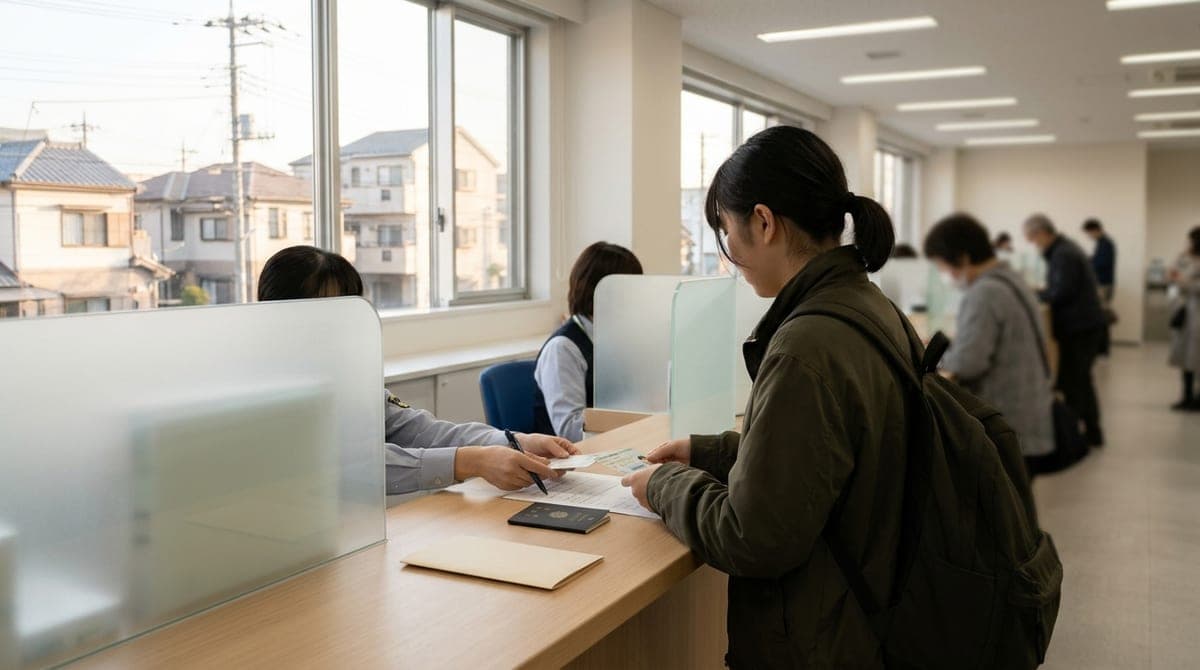
After arriving in Japan on a Student visa to attend a Japanese language school or university, you must register your address at your local municipal office within 14 days of moving into your home. This registration sets up your official Resident Record, updates your Residence Card, and registers you for National Health Insurance and the My Number system. Completing these official administrative steps promptly ensures you maintain legal resident status and gain access to essential public services.
What official city office procedures must international students complete within 14 days in 2026?
When you enter Japan for a period longer than three months, immigration officials at major entry airports—such as Narita, Haneda, Kansai, Chubu, New Chitose, Kobe, Hiroshima, or Fukuoka—issue a physical Residence Card alongside your Landing Permission stamp. If you enter through another airport, your passport will be stamped with a notice indicating your card will be issued later. According to the Study in Japan Official Website, you must carry your Residence Card at all times during your stay in Japan.
Within 14 days of settling into your fixed residential address, you are required to submit a moving-in notification to your local ward or municipal office. Bringing your Residence Card (or passport if your card is pending issuance) allows the municipal office to create your official Resident Record and print your new address onto the back of your Residence Card. Always confirm specific requirements directly with your local municipal office or the Immigration Services Agency, as individual circumstances may vary and this guide does not constitute legal advice.
How do you register for National Health Insurance and what does it cover?
Foreign residents staying in Japan for more than three months under a Student status of residence must enroll in National Health Insurance. As explained by the Akamonkai Medical Insurance Guide, presenting your National Health Insurance card at a clinic or hospital reduces your out-of-pocket medical costs by 70%, leaving you responsible for the remaining 30%. You must also present this health insurance card when applying to extend or change your status of residence.
If you bring family members to live with you in Japan, they must also be enrolled under the scheme. However, National Health Insurance does not cover every medical expense. Excluded services include:
- Regular physical checkups
- Cosmetic surgery and orthodontics
- Eye surgery (such as LASIK)
- Normal childbirth
- Traffic accidents
- Workplace or part-time job injuries and illnesses
What is the My Number system and how is it used?
Every registered resident in Japan receives a unique 12-digit social security and tax identification number called "My Number" (or Individual Number). This 12-digit number is completely separate from the 12-digit card number printed on your Residence Card.
After you register your address at the city office, a notification card containing your My Number will be mailed to your address. You can choose to apply for a plastic My Number Card featuring your photo via mail, smartphone, or computer. You may be asked to provide your My Number when completing official city office tasks, starting a part-time job, or processing international money transfers through a bank.
What should you do when moving to a new address or leaving Japan?
If your living situation changes, official procedures must be handled at the municipal office as outlined in the Hokkaido University International Student Handbook:
- Moving within the same municipality: Visit your local ward office within 14 days of moving. Bring your Residence Card and your My Number Card to update your registered details.
- Relocating to a different municipality: You must first visit your current municipal office to file a moving-out notification and obtain a moving-out certificate. Within 14 days of moving into your new home, take this certificate along with your Residence Card and My Number Card to your new local city office to file a moving-in notification.
- Leaving Japan permanently: Before returning to your home country upon completing your studies, you must visit your city office to submit a moving-out notice with your Residence Card. This step is not required for short, temporary visits home during school breaks.
How can you access medical assistance and emergency services in Tokyo?
In the event of a medical emergency, dialing 119 connects you directly to emergency services for an ambulance. For non-emergency medical guidance in Tokyo, the Tokyo Fire Department provides an Emergency Telephone Consultation Center reachable by dialing #7119 on a mobile phone or 03-3212-2323 in the 23 wards (042-521-2323 in the Tama area). Students seeking multilingual healthcare information can contact the AMDA International Medical Information Center at 03-6233-9266 or consult the NAVII Medical Information Net.
Finding a place to stay
When preparing to study at a Japanese language school or university, arrange your initial accommodation after your Certificate of Eligibility (COE) and Student visa are issued, well before your flight to Japan. Having a confirmed address ready prior to arrival ensures you can complete your 14-day resident registration smoothly. Many newcomers stay in a furnished monthly apartment first while settling into daily student life. OHAYO Stay offers furnished monthly apartments and rooms in Tokyo. Booking is online with a passport or ID and a credit card, with no guarantor, no key money and no agency fee required. Most homes have a minimum stay of 30 nights (shown on each listing).