Navigating your transition to study in Japan requires following a clear sequence of administrative steps. After receiving your Certificate of Eligibility (COE), you must secure your Student visa, complete airport immigration, register your address at the municipal office, and enroll in the mandatory health insurance system. This guide covers the essential timeline and procedural steps for international students preparing for their studies in 2026.
How do you get a Student visa using your Certificate of Eligibility?
Before entering Japan under the designated "Student" residential status—which can be granted for periods ranging from 6 months up to 4 years and 3 months depending on the Ministry of Justice's evaluation—you need a Certificate of Eligibility (COE). Typically, your educational institution in Japan acts as your proxy to submit the COE application to a regional immigration services bureau. During this process, immigration authorities require evidence of your financial capacity to cover living and academic expenses. Acceptable proof includes a financial sponsor's bank balance certificate, annual income documentation for the past year, and papers outlining the origin of funds.
Once the regional immigration office approves the COE, the physical document or official electronic notification is sent to you. You must then apply for your visa at the Japanese embassy or consulate responsible for your region. For details on specific local requirements, refer to official resources such as the JASSO Immigration Guidelines and guidance from the Consulate General of Japan Visa Requirements.
When applying for the visa, you will generally need to submit:
- A valid original passport containing available visa pages.
- A completed visa application form bearing an original handwritten signature (digital signatures are not accepted).
- A recent passport photo (2 x 1.4 inches, front view, white background, taken within 6 months).
- The original paper COE, a physical copy, or a printed copy of the official COE email.
Always check directly with your local Japanese diplomatic mission, as additional documentation or country-specific variations may apply.
What happens at the airport when you arrive in Japan?
When landing in Japan, you must present your passport, valid visa, and COE to immigration officers. Travelers can utilize the online service Visit Japan Web to complete quarantine, immigration, and customs declarations digitally prior to entry.
If you land at major international entry hubs—specifically Narita, Haneda, Chubu, Kansai, New Chitose, Kobe, Hiroshima, or Fukuoka Airport—immigration officers will place a Landing Permission stamp in your passport and hand you a physical Residence Card (zairyu card). If you enter through other regional airports, your passport will receive a stamp indicating that your Residence Card will be issued by mail after address registration. Foreign nationals staying in Japan for longer than three months must carry their Residence Card at all times.
If you plan to work part-time to help cover expenses, you must apply for "Permission to Engage in Activity other than that Permitted under the Status of Residence Previously Granted." You can submit this application directly at airport immigration upon arrival. This permit allows international students to work up to 28 hours per week, provided they are actively enrolled in school.
When and how do you complete resident registration in Japan?
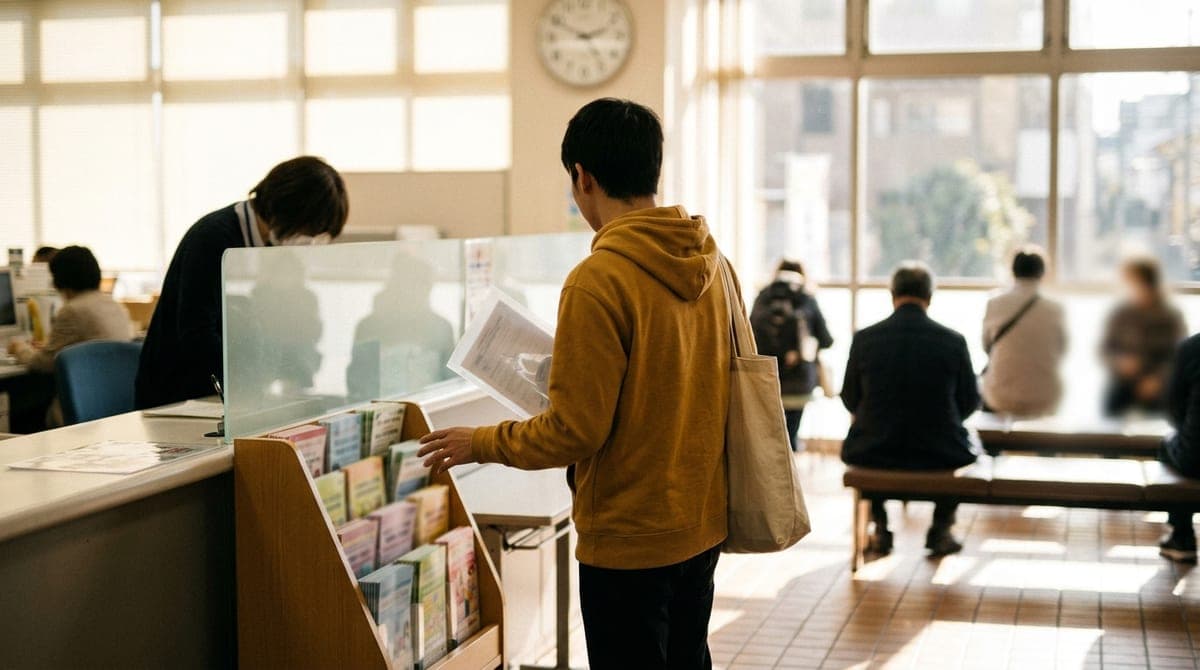
Within 14 days of deciding your residential address in Japan, you are legally required to visit the local municipal office (city or ward hall) administering your neighborhood. You must bring your passport and Residence Card (or stamped passport if the card was not issued at the airport). Detailed information on these requirements can be reviewed on the UTokyo International Student Arrival Procedures page.
After resident registration is completed, the government will send a notification regarding your 12-digit Individual Number, commonly known as "My Number." This tax and social security number is completely separate from the 12-digit ID number on your Residence Card. You will need your My Number for administrative city tasks, part-time job onboarding, and receiving or sending international bank transfers.
If you move to a new apartment during your studies, you must perform moving-out and moving-in procedures at both the old and new municipal offices within 14 days of moving. You can also request a free one-year mail forwarding service through Japan Post so that mail sent to your former residence is redirected automatically.
How does Japan's National Health Insurance work for international students?
All foreign residents residing in Japan for three months or longer must subscribe to the National Health Insurance (NHI or *Kokuho*). Registration is handled at your local municipal office right after completing your resident registration. Additional coverage policies are detailed in the JASSO Health Insurance Guide.
- Coverage and Costs: NHI pays 70% of eligible medical expenses, leaving the student responsible for the remaining 30% at clinics or hospitals. You must present your insurance card at every medical visit.
- Premium Calculation & Income Declaration: Monthly premiums are calculated based on your prior year's income in Japan. Even if you earned zero income or worked minimal part-time hours, you must file an income declaration at the city office to qualify for premium reductions.
- High-Cost Expenses: If medical bills in a single month exceed your individual limit, you can apply for a refund or request an eligibility certificate in advance to cap out-of-pocket costs at the hospital.
- Accident and Liability Insurance: To cover incidents not included in NHI—such as accidental kitchen fires, bicycle collisions causing injury, or personal property theft—schools often recommend supplemental coverage such as "Gakkensai" (Personal Accident Insurance for Students Pursuing Education and Research) or university co-op insurance.
Finding a place to stay
Arranging temporary housing should be done after your Certificate of Eligibility (COE) or visa is approved and prior to your departure for Japan. Having your initial accommodation reserved ensures you have a physical address ready for municipal registration soon after landing. Many newcomers choose to stay in a furnished monthly apartment when first arriving in Tokyo to settle in smoothly without long-term commitments right away. OHAYO Stay offers furnished monthly apartments and rooms in Tokyo; most homes have a minimum stay of 30 nights (shown on each listing). Booking is completed online with a passport or ID and a credit card, requiring no guarantor, no key money, and no agency fee. Furthermore, the monthly price includes electricity, gas, water and Wi-Fi, which simplifies setting up your household while you begin your studies.