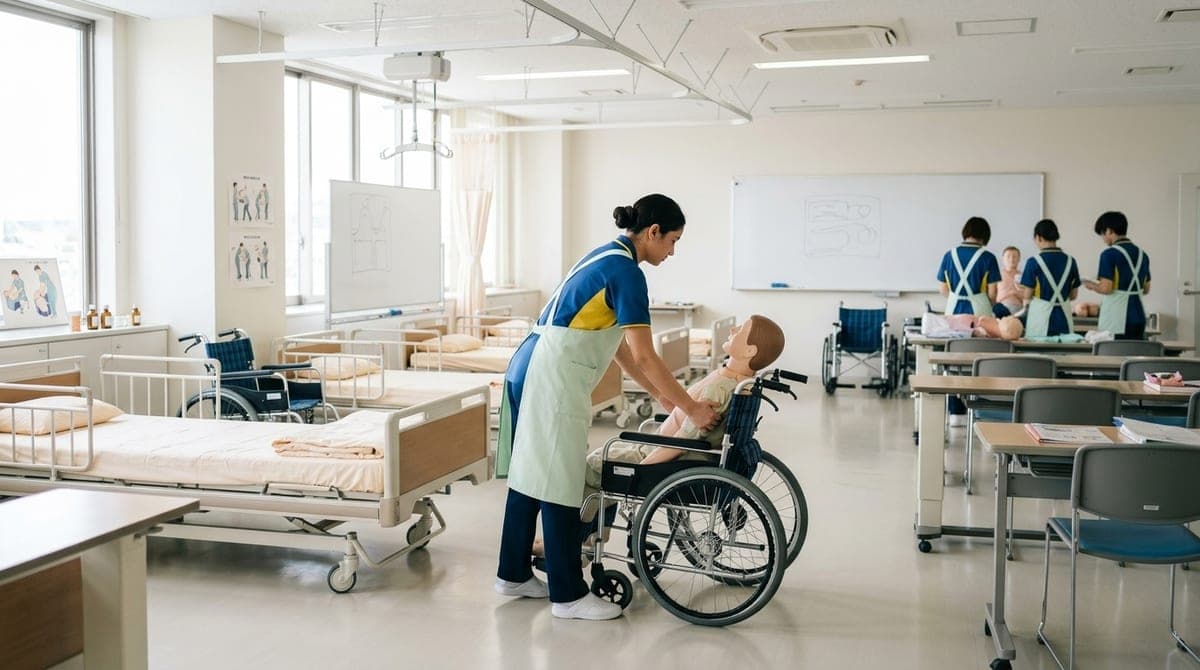
International students in Japan can study nursing care at a 2-year vocational school (*senmon gakko*) to earn the Certified Care Worker (*Kaigo Fukushishi*) national qualification and transition to the "Care" (*Kaigo*) status of residence. This work visa allows unlimited renewals without duty restrictions, offering equal working conditions and wages compared to Japanese staff, along with family accompaniment rights. Below is a comprehensive guide on school requirements, admission steps, financial support, and visa rules based on official institutional data.
What are the eligibility and Japanese language requirements for admission?
To enroll in a Japanese specialized training college (*senmon gakko*) for nursing care, international applicants must meet specific educational and language standards:
- Age and Education: Applicants must be at least 18 years old at the time of enrollment and have completed 12 years of regular school education abroad, or possess an equivalent qualification.
- Japanese Language Standards: Applicants must satisfy at least one of the following language criteria:
- Passed the Japanese-Language Proficiency Test (JLPT) at N3 level or higher.
- Scored 200 points or more on the Japanese as a Foreign Language subject of the Examination for Japanese University Admission for International Students (EJU).
- Completed 6 months or more of education at a Japanese language educational institution designated by the Minister of Justice.
- Completed 1 year or more of education at a Japanese school (elementary, junior high, high school, or university).
- Financial Capability: Applicants must demonstrate sufficient financial assets, scholarships, or funding to cover tuition and living expenses during their studies.
(Source: Tochigi Nursing Welfare School)
What is the step-by-step admission process?
Applying to a nursing care program follows a structured timeline:
- Open Campus and Individual Consultation (Recommended): Prospective students visit the campus or attend online individual consultations to learn about the curriculum and campus environment.
- Application Submission: Applicants submit the application form, official proof of Japanese language proficiency, and documentation showing sufficient financial support before the deadline.
- Entrance Examination: Candidates complete an interview and a brief written test designed to evaluate Japanese communication skills and motivation for caregiving.
- Results and Enrollment Procedures: Successful candidates receive pass notifications and must pay required tuition fees and submit enrollment paperwork by the set deadline.
- Visa Status Application or Renewal: Applicants update or renew their "Student" (*Ryugaku*) status of residence using official certificates of admission provided by the school.
(Source: Tochigi Nursing Welfare School)
What is covered in the 2-year nursing care curriculum?
Vocational school care programs provide extensive theoretical instruction and hands-on clinical practice:
- Course Hours: A typical 2-year program comprises 1,036 class hours in Year 1 and 906 class hours in Year 2, which includes 100 hours dedicated to medical care training.
- Specialized Japanese Support: Programs often incorporate specialized Japanese language classes during the first semester of Year 1 or offer dedicated international student classes taught in simplified Japanese.
- Core Subjects & Practical Skills: Students study life and care support techniques, care process practice, human body structures, developmental theory, and communication skills.
- Medical Care Exercises: Training includes tube feeding procedures, sputum suction methods, and CPR/AED emergency resuscitation to detect and handle physical abnormalities quickly.
- Exemption Benefits: Completing the accredited curriculum qualifies graduates to take the Certified Care Worker national examination and grants exemptions from both the Specified Skilled Worker No. 1 evaluation tests (the Kaigo Japanese Evaluation Test and Kaigo Skill Evaluation Test).
(Source: Sendai Medical and Welfare College; Ohara Academy)
How much is tuition and what financial loan programs are available?
Pursuing a nursing care qualification involves structured tuition costs and generous prefectural loan options:
- Tuition Overview: Standard 2-year tuition fees total approximately 2.26 million yen. Many schools offer special fee reduction systems for international students (e.g., a 360,000 yen discount), reducing tuition to around 1.9 million yen.
- Prefectural Loan Systems: Programs like the Miyagi Prefecture Care Worker Training Loan System provide interest-free loans up to 1.64 million yen over two years. When combining the tuition reduction and loan, out-of-pocket tuition costs can be reduced to as low as 520,000 yen for two years.
- Loan Forgiveness Conditions: If graduates work continuously for 5 years as care workers or consultation assistants in care facilities within the designating prefecture after graduation, the full loan repayment is waived.
- Key Financial Rules: Students apply for loans in April after enrollment. Because loan disbursements begin after August of Year 1, students must independently pay initial admission fees and first-term tuition upfront. A guarantor who is a Japanese national, Permanent Resident, or Special Permanent Resident is required prior to enrollment.
(Source: Sendai Medical and Welfare College; Yokkaichi Welfare College)
What are the rules and benefits of the Care (Kaigo) work visa?
Graduates who obtain the Certified Care Worker national qualification can transition to the "Care" (*Kaigo*) status of residence:
- Employment Rights & Duties: Holders of the Care visa experience no job duty restrictions and receive wages and working conditions equivalent to Japanese nationals. Eligible workplaces include special nursing homes, day service centers, hospitals, disability support facilities, and home help stations.
- Salary Statistics: According to the MHLW FY2024 Survey on Treatment of Care Personnel, the average monthly income for Certified Care Workers is approximately 350,000 yen, with an average annual income of approximately 4.2 million yen.
- Visa Renewal and Family Rules: The visa is granted for terms up to 5 years per renewal and can be renewed indefinitely with no upper limit as long as residence conditions remain valid. Spouses and children can reside in Japan under the "Dependent" (*Kazoku Taizai*) visa. Workers may also temporarily depart Japan and return to continue employment.
- Official Verification Notice: Visa eligibility and application rules depend on individual background and legal guidelines. Applicants should confirm all specific requirements with the Immigration Services Agency or official school advisors.
(Source: Sendai Medical and Welfare College; Ohara Academy)
Finding a place to stay
Arranging accommodation is essential once your enrollment is confirmed and your visa or Certificate of Eligibility is processed, prior to arriving in Japan or starting your term. Finding long-term rental housing in Tokyo can be challenging for incoming international students due to guarantor requirements. OHAYO Stay offers furnished monthly apartments and rooms in Tokyo. No guarantor, no key money and no agency fee; booking is online with a passport or ID and a credit card. Most homes have a minimum stay of 30 nights (shown on each listing). Securing a fully equipped apartment before classes begin provides a comfortable environment as you adapt to student life in Japan.