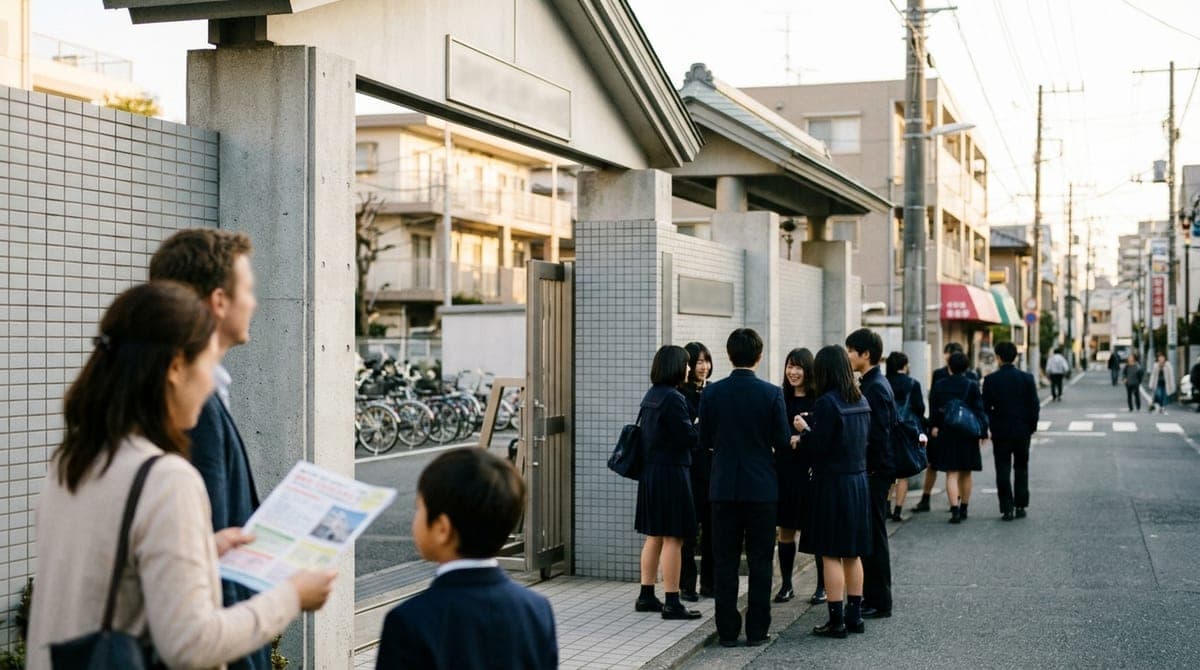
Foreign families moving to Tokyo can register their children for public elementary and junior high schools at any municipal office at any time. For students seeking entry into metropolitan high schools for April 2027, the Tokyo Metropolitan Board of Education conducts mandatory pre-application eligibility checks in November and December 2026. This guide details compulsory education rules, grade placement procedures, and official screening steps managed by MEXT and the Tokyo Metropolitan Government.
How does compulsory public schooling work in Tokyo for foreign children?
Compulsory education in Japan covers six years of elementary school (shogakko) starting the April after a child turned six, followed by three years of junior high school (chugakko). Under Japanese law, foreign national children residing in Japan are entitled to attend local public schools on the same basis as Japanese citizens.
- Tuition and Textbooks: Public elementary and junior high school tuition and textbooks are completely free. Families pay only for school supplies and extracurricular items. Municipalities offer financial grants for school expenses to families who encounter financial difficulties.
- Enrollment Procedure: Parents or guardians can complete enrollment paperwork at their local municipal ward office, city hall, town hall, or village office at any time of the year.
- Night School Options: Tokyo operates eight public junior high night schools for individuals who could not complete elementary or middle school education earlier in life.
- Support Center: The Tokyo Metropolitan Education Consultation Center provides general education guidance at 0120-53-8288 (free in Japanese, 24/7). Interpreter consultations in English, Chinese, and Korean take place on Fridays between 1:00 p.m. and 5:00 p.m. (registration closes at 4:00 p.m.).
What are the grade placement rules for returnees and foreign students?
Under Article 17 of the School Education Law, Japanese nationals (including dual citizens) residing in Japan are subject to compulsory education requirements upon returning to the country. Municipal education committees assign students to schools based on their resident records.
- Age-Appropriate Placement: Returning and foreign students are generally placed in the grade corresponding directly to their chronological age.
- Postponement of Obligations: Under Article 18, if a child's Japanese language skills are so limited that basic education conditions are absent, attendance obligations may be temporarily postponed, provided the child receives appropriate Japanese instruction at a designated institution.
- Temporary Lower Grade Placement: Schools may temporarily place a student in a lower grade to help them adjust to school life before returning them to their age-appropriate grade mid-term. On official school cumulative guidance records (shido yoroku), the student remains listed under their age-appropriate grade.
- Permanent Lower Grade Placement: If language barriers remain exceptionally severe, schools may officially place the student in a lower grade on their record until middle school completion, following explicit agreement from the parent and student.
Who is eligible for the April 2027 Tokyo metropolitan high school foreign student selection?
Foreign national students and returnees seeking entry into Tokyo metropolitan high schools for April 2027 must attend a pre-application eligibility screening hosted by the Tokyo Metropolitan Board of Education.
Applicants must live in Tokyo with a parent or guardian (or relocate to Tokyo before the high school admission date and commute from their home in Tokyo). An exception exists for Hitotsubashi High School, Asakusa High School, Ogikubo High School, and Sunagawa High School, where applicants must live or work in Tokyo without needing the same address as a guardian.
Applicants must require Japanese language support and meet one of the following conditions:
- Expecting to graduate from a Japanese junior high school by March 31, 2027, and having lived in Japan for three years or less by the date of admission (arrived on or after January 1, 2024).
- Having already graduated from a Japanese junior high school with three years or less of total residence in Japan.
- Expecting to complete or having completed nine years of education in their home country by March 31, 2027.
- Holding a foreign passport and expecting to complete or having completed education equivalent to Japanese junior high school at a foreign school in Japan by March 31, 2027.
- Expecting to complete or having completed education equivalent to Japanese junior high school at a Japanese school abroad by March 31, 2027.
When and where is the pre-application eligibility check conducted?
The pre-screening sessions for April 2027 admission take place at the Tokyo Metropolitan Government Main Building No. 1, 5th Floor Main Conference Hall (2-8-1 Nishi-Shinjuku, Shinjuku-ku, Tokyo). Attendees pick up a yellow entry pass on the 1st floor near the north side elevators.
- Session Dates: November 15, 2026 (Sunday) and December 6, 2026 (Sunday). A secondary session on December 20, 2026 (Sunday) is reserved exclusively for participants who attended in November or December but could not complete their eligibility check.
- Time Slots: Session 1 (10:30 a.m.–11:30 a.m.), Session 2 (11:30 a.m.–12:30 p.m., arrival by 12:00 p.m.), Session 3 (1:30 p.m.–2:30 p.m.), and Session 4 (2:30 p.m.–4:30 p.m., arrival by 4:00 p.m.).
- Capacities & Online Reservations: Pre-booking online (open from October 13, 2026) is mandatory. Capacity varies from 30 to 120 slots per session.
- Language Support: On-site interpreters are available in eight languages (English, Chinese, Tagalog, Nepalese, Spanish, Thai, Vietnamese, and Korean). Requests for additional languages required notification by phone (03-5320-6745) by November 6, 2026.
What documents must be brought to the screening session?
All applicants must present completed pre-screening application forms filled out in Japanese or English. Additional documents depend on the student's schooling background:
- Passports and Residence Cards: Both student and guardian passports and residence cards are required to calculate residence duration. If residence cards were renewed or issued on or after June 14, 2026, landing permission dates are verified via passport stamps or official entry/exit records from the Immigration Services Agency.
- Residence Certificates: Tokyo residents must bring a Certificate of Items Listed in the Certificate of Residence (Form 3) issued on or after November 1, 2026.
- School Records: Official student handbooks, transcripts, or certificates of expected graduation showing nine years of schooling completed.
- Out-of-Tokyo Residents: Applicants relocating to Tokyo before high school admission must submit Form 1 (Application for Approval) and Form 5 (Declaration Concerning Return to Home Country) at the time of application.
Finding a place to stay
When preparing for school enrollment or attending mandatory high school pre-screening sessions in Shinjuku, arranging temporary accommodation early makes the transition smooth. Families often set up their housing after obtaining entry approvals or visas and before arriving in Tokyo. Establishing a local base allows guardians to register their address at the ward office promptly to obtain residence certificates needed for school applications. Many newcomers stay in a furnished monthly apartment first while navigating school admissions. OHAYO Stay offers furnished monthly apartments and rooms in Tokyo, where most homes have a minimum stay of 30 nights. Booking is completed online with a passport or ID and a credit card, requiring no guarantor, key money, or agency fee.