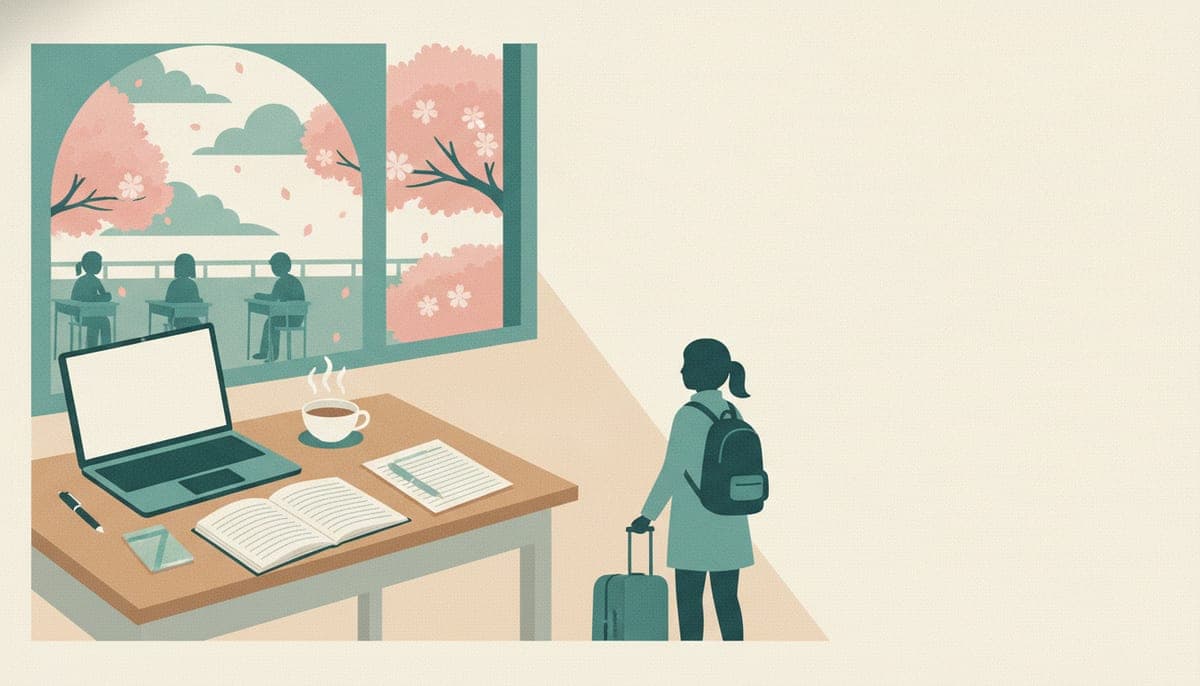
If you are planning to attend a Japanese language school or university in 2026 while staying in Japan on a short-term status, you might wonder whether you can convert your status directly while in the country. Under official immigration guidelines, individuals who travel to Japan under visa exemptions or short-term exam stay rules are generally required to return to their home country to finalize their visa at an embassy or consulate after passing their exams. Navigating the Certificate of Eligibility (COE) application, embassy paperwork, and initial resident registration steps is essential for a seamless arrival as an international student.
Because individual circumstances vary and immigration rules are enforced strictly, this guide presents standard procedural facts. Readers should always confirm their eligibility and specific requirements directly with official government resources such as Study in Japan or regional immigration offices.
How does the Student status of residence work in Japan for 2026?
The status of residence designated for education covers individuals taking courses at accredited Japanese language schools, specialized training colleges, colleges of technology, junior colleges, or universities. The Japanese Minister of Justice sets the exact period of stay granted to each individual applicant, which can extend up to a maximum duration of 4 years and 3 months.
Can you change from tourist status to a Student visa inside Japan?
If you enter Japan on a Temporary Visitor visa to take an entrance exam (which permits stays of 15, 30, or 90 days based on the exam voucher) or under a bilateral Visa Exemption Arrangement, the standard rule requires you to return to your home country after passing the exam. You must then secure your Student visa through a Japanese embassy or consulate abroad before re-entering Japan for your studies. Direct status alterations inside Japan are restricted under standard immigration protocol, making it vital to plan your travel timeline around official application channels.
How to apply for a Certificate of Eligibility (COE) and visa
Step 1: School proxy application for the COE
Before obtaining your visa, a Certificate of Eligibility (COE) must be issued by a regional immigration services bureau in Japan. In almost all situations, your accepted educational institution acts as your authorized proxy to submit this application on your behalf. You should coordinate directly with your school to provide the required personal and academic paperwork.
Step 2: Proof of financial capability
Immigration authorities require evidence demonstrating that you or your financial sponsor can cover all living and tuition expenses during your stay in Japan. Accepted proof includes:
- A bank savings balance certificate from the financial sponsor (the student or their guarantor).
- An official income certificate detailing the sponsor's earnings over the previous year.
- Clear documentation verifying the specific sources of funds.
Step 3: Submitting your visa application abroad
Once the regional immigration services bureau issues your COE, you can apply for your visa at the Japanese embassy or consulate in your home country or country/region of residence. The required submission package generally includes:
- Your valid passport.
- The official visa application form with required photographs.
- The original or a copy of your issued COE.
- Any supplementary documents requested by the diplomatic mission.
What procedures must you complete upon entering Japan?
Airport immigration and Residence Card issuance
When entering Japan, you must present your valid passport, the visa issued by the embassy or consulate, and your COE (a copy is acceptable). You can also complete quarantine, immigration, and customs declarations in advance online using the Visit Japan Web service.
If you land at major international hubs—such as Haneda, Narita, New Chitose, Chubu, Kansai, Kobe, Hiroshima, or Fukuoka Airport—immigration officers will place a Landing Permission stamp in your passport and issue your physical Residence Card (*zairyu card*) immediately. If you arrive via any other airport, your passport will receive a stamp indicating that your Residence Card will be issued at a later date. Keep in mind that all mid-to-long-term foreign residents remaining over three months must carry their Residence Card at all times.
Municipal address registration and My Number
Within 14 days of establishing your residential address in Japan, you are required to visit your local municipal office to register your resident address. If your Residence Card was deferred at the airport, bring your stamped passport to the municipal office to finalize your card's processing.
After resident registration is finished, you will receive a notification card by mail containing your 12-digit Individual Number, commonly known as "My Number." This social security and tax identification number is entirely separate from the 12-digit number printed on your Residence Card. Your My Number is mandatory when setting up part-time employment, conducting foreign currency bank transfers, or completing specific administrative procedures.
Finding a place to stay
Arranging accommodation should happen after your school confirms your COE application progress, ideally before you board your flight to Japan. Having a fixed local address ready ensures you can easily complete your mandatory 14-day municipal address registration upon arrival. Many newcomers stay in a furnished monthly apartment first to give themselves immediate stability while settling into student life. OHAYO Stay offers furnished monthly apartments and rooms in Tokyo; most homes have a minimum stay of 30 nights (shown on each listing). The monthly price includes electricity, gas, water and Wi-Fi. Booking is handled conveniently online without needing a guarantor, key money, or agency fees.
FAQ
Can I change my tourist status to a Student status without leaving Japan?
As a general rule, nationals under visa exemption arrangements or temporary visitor exam visas must return to their home country after passing their exams to obtain a Student visa from a Japanese embassy or consulate abroad.
How long can a Student status of residence be granted for?
The specific period of stay is determined by the Minister of Justice for each applicant, with a maximum limit of up to 4 years and 3 months.
What is the deadline to register my address after arriving in Japan?
You must bring your Residence Card (or stamped passport) to your local municipal office within 14 days of determining your residential address in Japan.
Sources
- Study in Japan(JASSO)「Immigration and Students Visas|Study in Japan Official Website」(checked 2026-11-02)
This article was created by OHAYO Stay based on the sources above (edited, reorganized and translated). It is not an official publication.
Rules and dates can change. Always confirm with the official source before you apply.