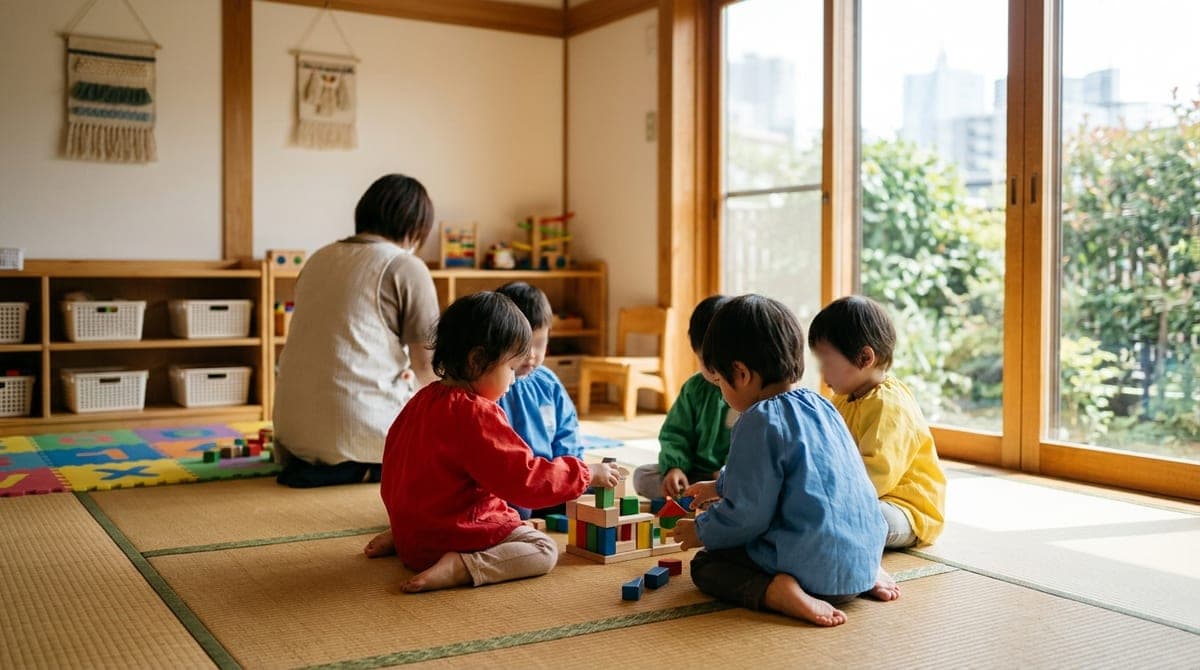
Foreign parents moving to Japan with young children in 2026 can rely on national policy initiatives designed to improve support for foreign-national children in Japanese childcare facilities. Managed under the Children and Families Agency (Children and Families Agency Website), dedicated research projects and best-practice resources help local municipalities and nursery schools better serve non-Japanese children and their guardians. Understanding how national guidelines and municipal support frameworks operate helps international families navigate childcare options when settling in Japan.
What official measures support foreign children in Japanese childcare in 2026?
In recent years, the number of foreign-national children attending nursery schools and related childcare facilities (保育所等) across Japan has steadily increased. To address this growth, the Japanese government established explicit administrative targets under a formal decision made by the Cabinet Ministers Council on Comprehensive Measures for Acceptance and Coexistence of Foreign Human Resources (外国人材の受入れ・共生に関する関係閣僚会議).
This policy, adopted on July 14, 2020, under the title "Enhancement of Comprehensive Measures for Acceptance and Coexistence of Foreign Human Resources" ("外国人材の受入れ・共生のための総合的対応策の充実について"), mandated national and local efforts to enhance support for foreign children and parents. Specifically, the mandate requires gathering examples of local initiatives, conducting hearings with local governments and nursery facilities, evaluating municipal support frameworks, and ensuring that good practices are shared horizontally across municipalities throughout Japan.
What research and guidance exist for nurseries and local municipalities?
To implement the Cabinet Ministers Council decision, research studies were commissioned under the national Child and Childcare Support Promotion Research Project (子ども・子育て支援推進調査研究事業). Conducted by Mitsubishi UFJ Research and Consulting Co., Ltd. (三菱UFJリサーチ&コンサルティング株式会社), these studies produced detailed analytical reports and practical case study collections for municipal policy planning:
- Fiscal Year 2019 Study: Titled "Research and Study on Response to Foreign Children and Parents in Nursery Schools, etc." ("保育所等における外国籍等の子ども・保護者への対応に関する調査研究"), this project evaluated facility-level responses. It produced a case studies collection (事例集, 3,878 KB) and a comprehensive research report (報告書, 12,845 KB).
- Fiscal Year 2020 Study: Titled "Research and Study on Childcare for Foreign Children, etc." ("外国籍等の子どもへの保育に関する調査研究"), this project expanded on earlier findings. It compiled a collection of key implementation points and case studies (取組ポイント集/事例集, 936 KB) alongside a detailed report (報告書, 4,442 KB).
These research materials serve as foundational reference documents for local governments seeking to establish inclusive childcare environments and clear communication channels for foreign families.
How do Japanese municipalities and nursery facilities assist foreign parents?
Local municipal offices (市町村) and nursery care facilities (保育所等) utilize these national research outcomes to improve daily support mechanisms for foreign residents. Key administrative objectives include:
- Assessing local reception systems: Municipalities examine their internal frameworks for receiving foreign-national children, ensuring that application procedures and parent consultations are accessible.
- Collecting local support cases: Gathering concrete examples from childcare centers that have successfully assisted non-Japanese children and parents.
- Horizontal dissemination of best practices: Promoting the nationwide spread ("好事例等の横展開") of proven communication methods, administrative considerations, and childcare support models so that all local municipalities can learn from successful examples.
By building on these centralized research insights, Japanese municipal governments work to ensure that nursery schools provide supportive environments tailored to foreign-national children and their guardians.
Where can families access official research and reports?
International residents, researchers, and local administrators can access these official publications directly on the Children and Families Agency Website. The portal hosts complete downloadable PDF reports and case study collections from both Fiscal Year 2019 and Fiscal Year 2020. Reviewing these materials allows parents to understand the administrative guidelines and support structures that inform municipal childcare policies across Japan.
Finding a place to stay
When planning a move to Japan with your family, arranging suitable housing well before arrival or during your visa application phase ensures a smoother transition. Having an established residential address helps when interacting with local ward or city offices for residency registration and childcare consultations. OHAYO Stay offers furnished monthly apartments and rooms in Tokyo, providing a flexible option for families arriving in Japan. Most homes have a minimum stay of 30 nights (shown on each listing), giving parents ample time to explore local neighborhoods and complete initial administrative tasks. Furthermore, the monthly price includes electricity, gas, water and Wi-Fi, eliminating the stress of utility setups during your initial move.