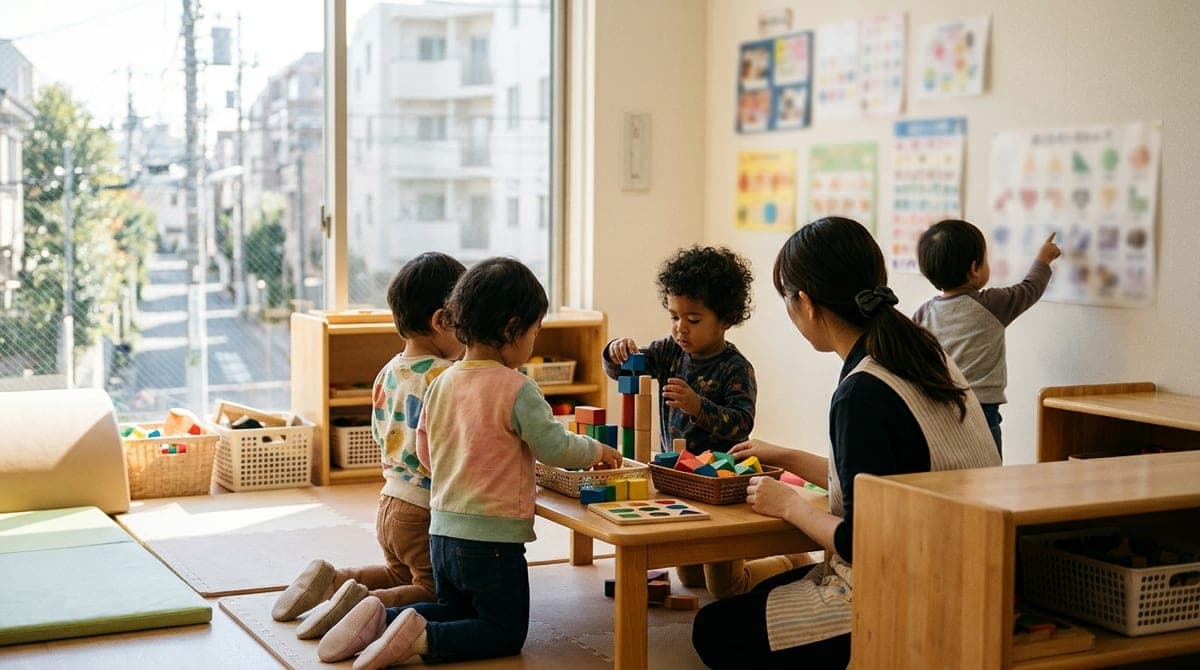
If you are moving to Japan with young children, all 3- to 5-year-olds are eligible for free early childhood education and care across recognized facilities. Children aged 0 to 2 can also receive free care if their household is exempt from municipal taxes. Parents moving for study or work can enroll their children in local nursery schools, kindergartens, or public elementary and junior high schools by following specific administrative steps.
Who qualifies for free early childhood education in Japan?
Japan's early childhood education and care policy reduces financial burdens on families by subsidizing costs for eligible children. Under this system, all children between 3 and 5 years of age qualify for free early childhood education and care regardless of family income. For younger children aged 0 to 2, free care services are provided specifically to low-income households that are exempt from paying municipal taxes.
According to official guidance from institutions like the Tohoku University International Support Center, several types of facilities fall under this policy:
- Kindergartens: Educational institutions primarily serving children aged 3 to 6.
- Nursery Schools: Facilities offering basic care and socialization for children from 0 to 6 years of age.
- Certified Childcare Centers: Integrated centers (*nintei kodomoen*), specifically covering their kindergarten sections.
- Licensed Childcare Facilities: Approved facilities that fulfill designated municipal requirements under specific conditions.
Parents should confirm exact eligibility details and individual facility coverage with local ward office authorities upon registering their residence.
What is the difference between nursery schools and kindergartens?
Choosing between a licensed nursery school and a kindergarten depends on your child's age, daily work schedule, and educational preferences.
Licensed Nursery Schools
Licensed nursery schools cater to children from 0 to 6 years old. Their primary objective is to provide basic daily care, socialization, and play-oriented activities for children whose guardians cannot provide childcare at home during the day.
- Eligibility: Both parents must demonstrate a genuine need for childcare based on their employment or study status. Applicants must be registered residents in the municipality.
- Application: Guardians submit their applications directly to the local ward office.
- Hours & Fees: Operating hours are longer, often covering full workdays and offering extended care. Fees are set based on household income, with subsidies available for eligible families.
Kindergartens
Kindergartens cater to children aged 3 to 6 with a primary focus on early childhood education, preparing children for formal schooling through fundamental learning in reading, writing, and basic mathematics.
- Eligibility: Admission relies primarily on age (the child must be at least 3 years old) rather than parental employment status.
- Application: Guardians apply directly to the individual kindergarten, although certain facilities may require an additional childcare application through the ward office.
- Hours & Fees: Daily schedules are shorter, typically lasting 3 to 4 hours from morning to early afternoon, though some offer after-hours care. Fees and exemption systems vary depending on the school.
How do parents apply and what deadlines must they meet?
The application process and timeline depend on the chosen facility type and your arrival schedule in Japan.
For licensed nursery schools, parents must obtain a Certificate of Need for Childcare from the ward office. To enroll a child on the 1st of any month, the complete application must be submitted to the ward office by the 5th of the preceding month. To start on the 16th of a month, the application deadline is the 20th of the preceding month.
After submitting documents, guardians and children must complete a pre-enrollment interview and a health check-up before final admission is confirmed.
Foreign families holding mid-to-long-term residence status can begin nursery applications prior to arriving in Japan only if their residential address in the municipality is fully confirmed in advance. If your address is not confirmed prior to arrival, all application steps must be completed at the ward office after your physical arrival in Japan.
For kindergartens, parents search municipal lists, contact the school directly to request application details, submit required documents, and complete the pre-enrollment interview and child health check-up.
How does school enrollment work for elementary and middle school children?
Compulsory education in Japan lasts nine years, comprising six years of elementary school and three years of junior high school. While Japanese citizens are legally obligated to send their children to compulsory school, this legal mandate does not extend to foreign residents. However, foreign parents have the right to enroll their children in public schools by completing local administrative procedures.
Public Schools and District Systems
Public elementary and junior high schools are managed by local municipal boards of education. Tuition at public schools is free, although parents pay out-of-pocket expenses for school materials, uniforms, and school lunches.
Public schools operate on a strict district system, meaning children attend the designated public school assigned to their residential area. Parents holding mid-to-long-term residence status submit public school applications to the local Board of Education.
Families on short-term visas or short-term residence status (a stay period of less than 90 days) may request "Trial Enrollment" directly through a public school. However, acceptance remains entirely at the school's discretion, and schools reserve the right to decline trial applications.
To assist non-native speakers, some public elementary schools offer specialized international classes or supplementary Japanese language support, while others may not. Parents should check language support availability when choosing their residential location.
Private and International Schools
Families seeking instruction in English or other foreign languages can opt for private international schools. Institutions accredited by recognized regional bodies, such as the Western Association of Schools and Colleges (WASC), offer programs from kindergarten through grade 12 (K-12). High school graduates from WASC-accredited international schools qualify for university entrance in Japan and worldwide. Other international options include immersion programs aligned with Japanese curriculum guidelines.
Finding a place to stay
When relocating to Japan with family, securing housing is an essential step before beginning school registration. Because municipal public school district assignments and nursery application processes require a confirmed residential address, families should arrange their accommodation as soon as their visa or Certificate of Eligibility is finalized. OHAYO Stay offers furnished monthly apartments and rooms in Tokyo, making the move straightforward for arriving families. Most homes have a minimum stay of 30 nights (shown on each listing). No guarantor, no key money and no agency fee; booking is online with a passport or ID and a credit card. Establishing your address early allows you to register at the ward office promptly and start school procedures without delay.