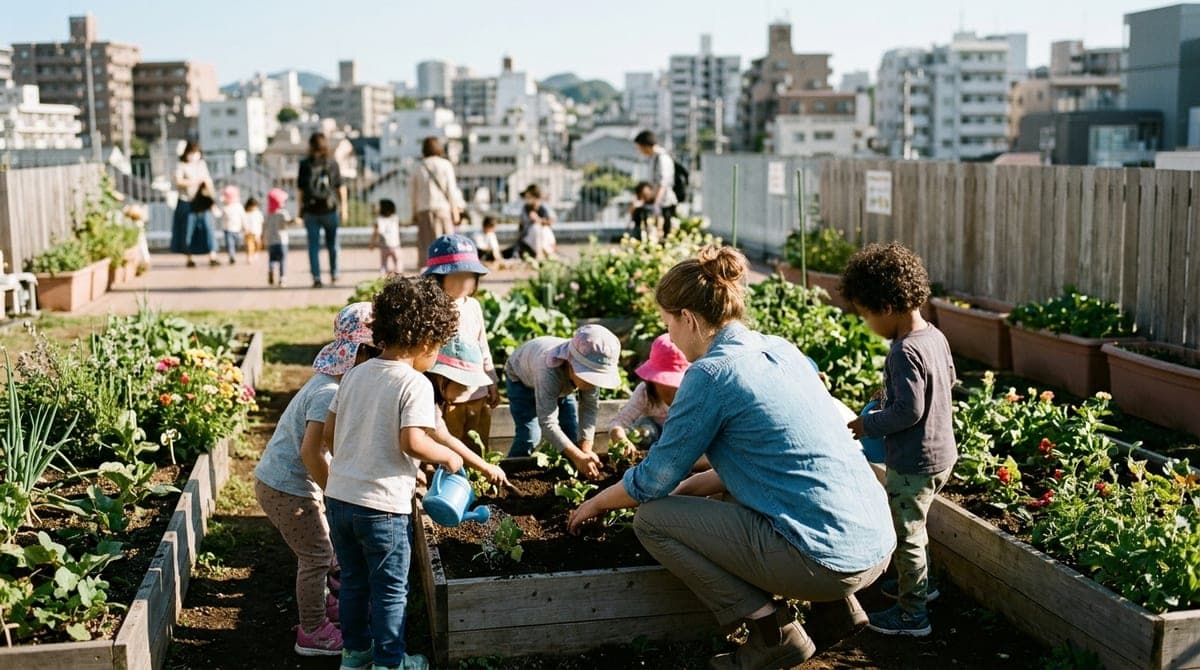
Foreign families moving to Tokyo for study or work must navigate a multi-tiered childcare system consisting of licensed kindergartens, licensed nurseries, and unlicensed facilities, which include many international preschools. Licensed kindergartens focus on early education under school standards, while licensed nurseries provide daily care with specific capacity rules. Unlicensed international preschools operate outside standard school accreditation but remain subject to mandatory government notification, written reporting, and regular on-site inspections under Japanese child welfare regulations.
How are kindergartens, nurseries, and international preschools categorized in Tokyo?
What defines a licensed private kindergarten?
In Japan, licensed private kindergartens are established primarily by educational corporations, as outlined in local administrative rules such as the Daisen City Regulations. These institutions must strictly conform to national standards regarding class sizes, physical facilities, classroom equipment, and teacher ratios. Additionally, their official names must be clearly distinguishable from other existing kindergartens in the municipality to prevent confusion. Their physical location must maintain an appropriate environment for school education while ensuring stable long-term child enrollment quotas.
What are the standards for a licensed nursery?
According to the MHLW Nursery Licensing Guidelines, licensed nurseries can be managed by social welfare corporations or non-social welfare entities that possess sound financial bases and social credibility. Non-social welfare operators must employ executives or staff with at least two years of childcare or social welfare experience, or establish an advisory committee representing parents and experienced staff. Standard licensed nurseries generally maintain a minimum capacity of 60 children, though authorized smaller facilities can operate with 10 to 60 children. Operating entities must submit financial balance sheets, income statements, and reserve reports to the prefectural governor before the end of each fiscal year. If a nursery fails to maintain proper standards, prefectural governors can issue corrective orders, suspend operations, or revoke official licensing.
How do international preschools fit into the legal framework?
Many international preschools in Tokyo operate as unlicensed childcare facilities because they offer specialized bilingual or foreign-curriculum programs outside the accredited school system. Under the MHLW Unlicensed Childcare Guidance, any facility caring for young children away from their parents for at least 4 hours per day, 5 days per week, and 39 weeks per year is legally considered to be providing childcare. Consequently, these facilities fall directly under the supervision of the Child Welfare Act, requiring them to comply with official inspection and disclosure standards regardless of their internal educational labeling.
How can foreign parents evaluate and check a childcare facility?
What notifications and disclosures must unlicensed facilities provide?
Operators of unlicensed childcare facilities are required by law to submit a formal notification to the prefectural governor or designated city mayor within 1 month of commencing operations. The same 1-month reporting deadline applies when changes occur to key operational details or when a facility closes or suspends operations. Failure to submit this notification or submitting false information can result in administrative fines of up to 500,000 yen under non-contentious case procedures. Facilities must also provide clear public disclosures to parents, both on-site and through written or electronic documents. These disclosures must detail operating hours, fee structures (including tuition, meal costs, admission fees, and cancellation charges), staff configurations (calculated by dividing the total daily working hours of staff by 8), insurance coverage caps, emergency medical partners, and any past history of administrative suspension orders.
How do government inspections and annual monitoring work?
To ensure child safety, local authorities monitor unlicensed facilities through mandatory annual written operating reports and regular on-site inspections. Notification-subject facilities receive an on-site inspection at least once per year in principle. For long-running facilities with exemplary compliance records, on-site inspections may be conducted every other year, though annual written reporting remains compulsory every year. Facilities classified as "baby hotels"—such as those operating past 8:00 PM, offering overnight care, or serving temporary care children for 50% or more of their total enrollment—must undergo mandatory on-site inspections every year without exception. Temporary setups operating for up to 6 months (such as event childcare) or care confined strictly to 4th-degree relatives are exempt from notification, but authorities retain full powers to inspect any facility if safety issues or complaints arise.
Finding a place to stay
When moving to Tokyo with your family, arranging your temporary housing early makes the transition smooth while you research local preschools and complete administrative registrations. Many newcomers stay in a furnished monthly apartment first to explore different neighborhoods before choosing long-term schooling. OHAYO Stay offers furnished monthly apartments and rooms in Tokyo, helping international families settle quickly upon arrival. Most homes have a minimum stay of 30 nights (shown on each listing), giving parents plenty of time to visit schools and inspect facilities in person. Furthermore, booking is online with a passport or ID and a credit card, allowing you to secure your living space easily before traveling to Japan.